The house tells you when the foundation is moving. Here's how to listen.
Foundation movement shows up in three places: the living space, the basement and the outside of the house. One sign alone often means little. Several together, getting worse, means call.
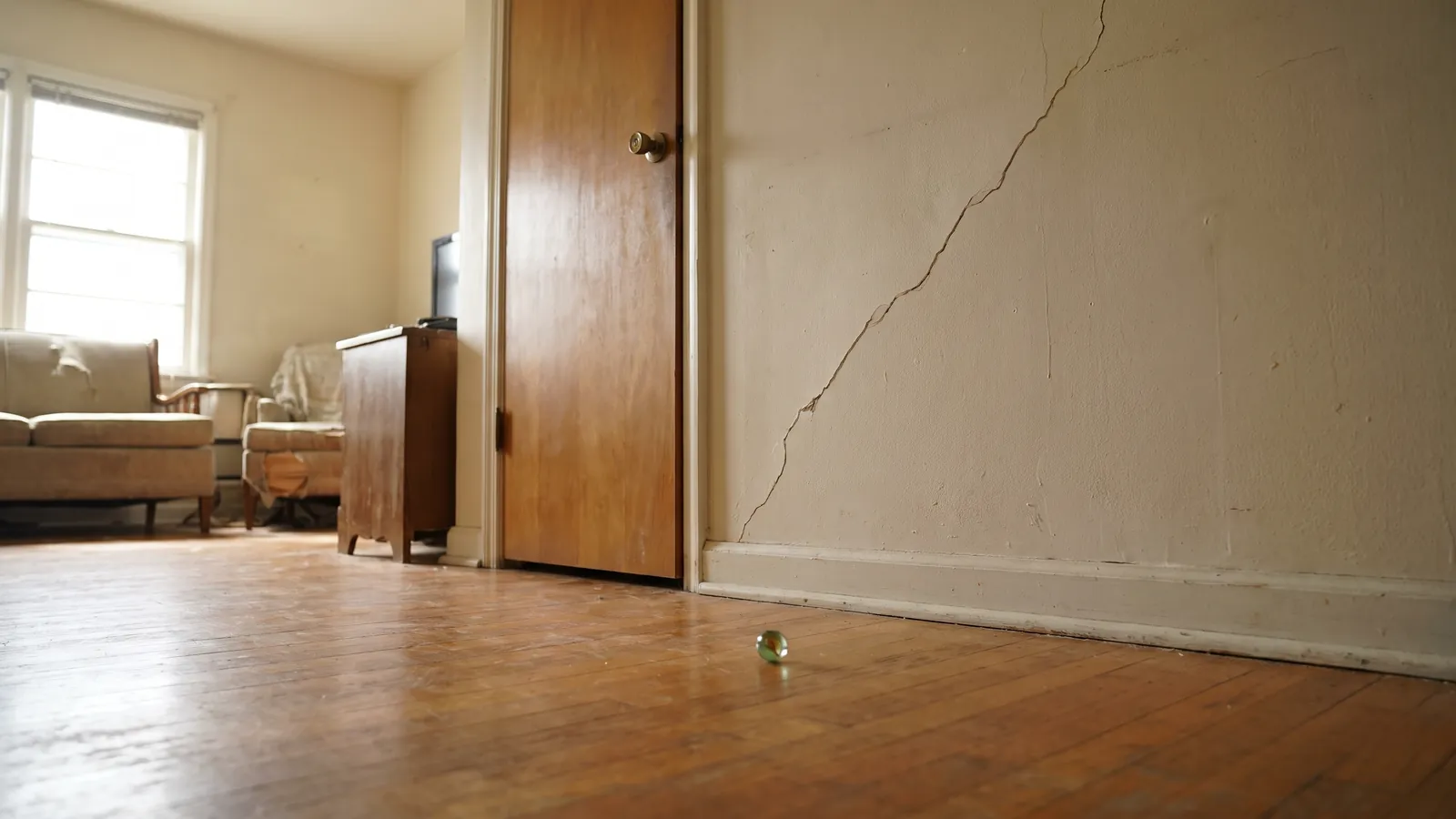
Upstairs
- Doors that stick or swing open by themselves, especially if they used to close fine. Look for a wedge-shaped gap at the top of the frame.
- Cracks from the corners of doors and windows, running diagonally up toward the ceiling.
- Floors that slope. Set a marble or a ball on the floor; if it rolls the same way every time, note which way.
- Gaps where walls meet ceilings, or crown molding pulling away.
- Windows that won't open or lock, out of square in their frames.
In the basement
- Horizontal cracks in a block wall, often a third to halfway up. This is the one not to wait on.
- Stair-step cracks through mortar joints near a corner.
- Walls that bow: hold a long level or a straight board against the wall and look for a gap in the middle.
- Cracks wider at one end than the other in a poured wall.
- Water or white chalky efflorescence at cracks and along the floor edge.
- A wall shifting at the bottom, away from the floor slab.
Outside
- Stair-step cracks in brick, or brick separating at window frames and corners.
- A chimney leaning or a gap opening between it and the wall.
- Porches, steps and stoops pulling away from the house.
- Soil pulled away from the foundation in a dry August, leaving a gap you can put fingers into.
- Downspouts emptying against the wall, and puddles that stay for days.
Which signs are urgent?
Call soon: a horizontal crack with visible bowing, a wall sliding at the bottom, a crack that grew noticeably over a few weeks, water coming in through a crack, or doors throughout one side of the house binding at once.
Old, thin, stable cracks are common in Kansas City houses and often need nothing more than a pencil mark at each end and a look next season. If you can't tell which kind you have, that's what the free inspection is for.
Quick questions
Is a crack in the drywall a foundation problem?
Not always. Drywall cracks at seams can come from framing shrinkage or humidity swings. Diagonal cracks from door and window corners, especially several on one side of the house, point more toward settlement.
Do all old houses have some settling?
Most have some, and much of it stopped long ago. The question is whether it's still moving, which measurements over time answer.
What should I photograph before calling?
The cracks with a tape measure for scale, any water, the outside wall below the crack, and where the downspouts empty.